
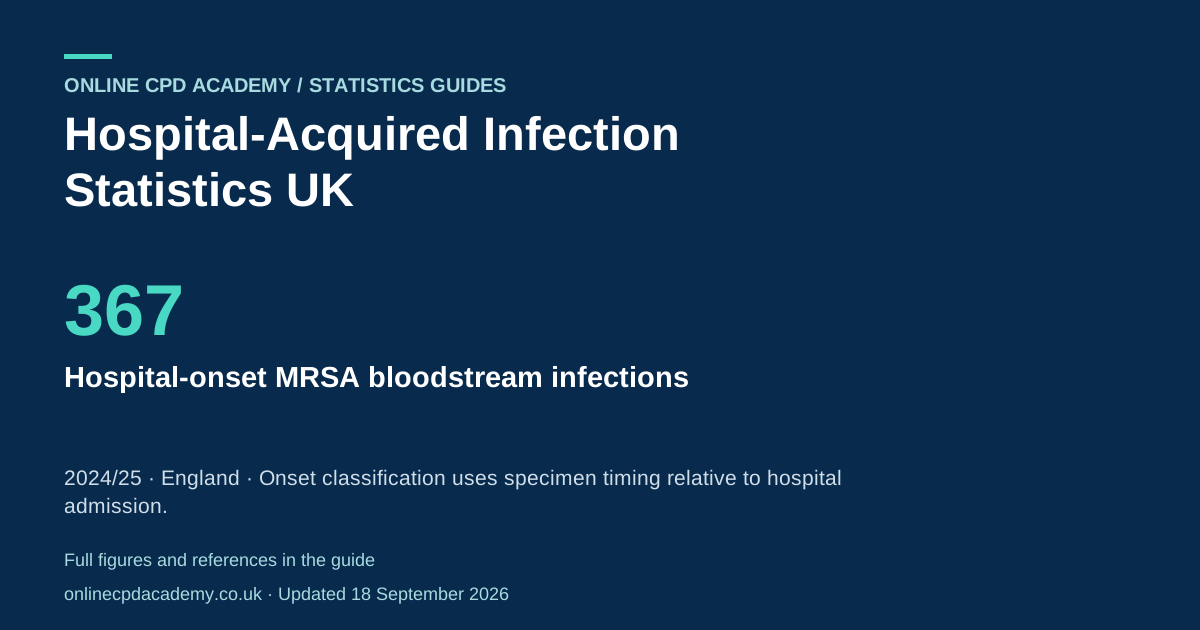
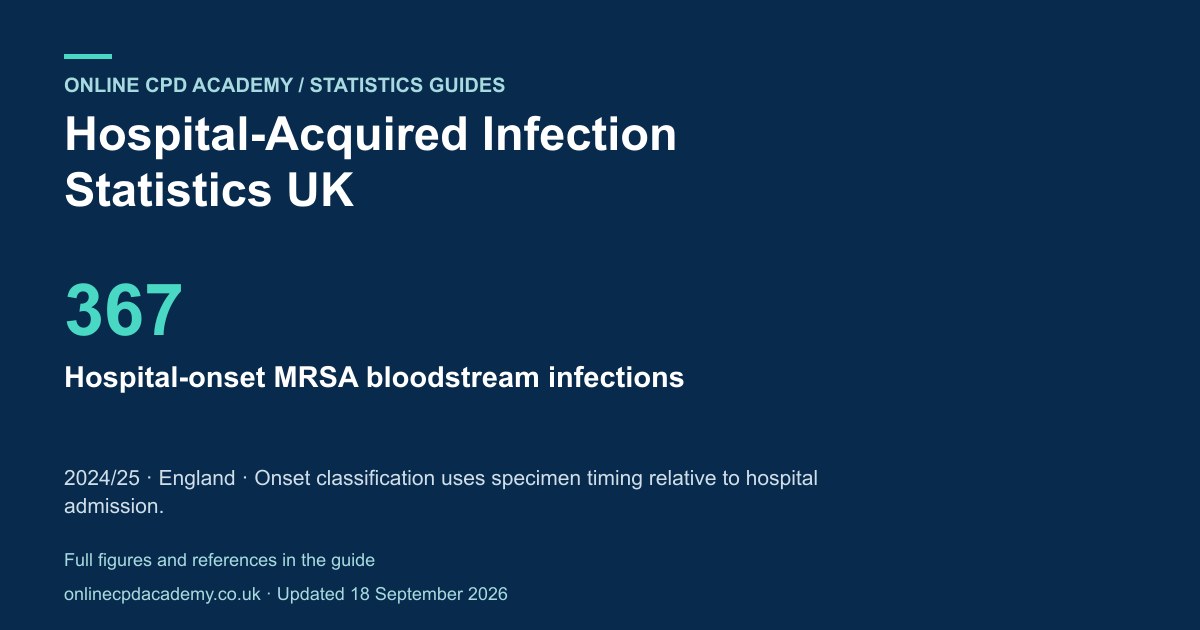
England recorded 367 hospital-onset MRSA bloodstream infections in 2024/25, within 1,064 MRSA infections reported across hospital and community-onset categories. The latest quarterly figures show that the MRSA rate was higher than a year earlier, while the C. difficile rate fell.
Key statistics at a glance
| Statistic | Figure | Period and coverage |
|---|---|---|
| Hospital-onset MRSA bloodstream infections | 367Onset classification uses specimen timing relative to hospital admission. | 2024/25 England |
| MRSA bacteraemia, all reported | 1,064367 were hospital-onset (34.5%). | 2024/25 England |
| MSSA bacteraemia, all reported | 13,799Meticillin-susceptible S. aureus. | 2024/25 England |
| E. coli bacteraemia, all reported | 43,6398,397 were hospital-onset (19.2%). | 2024/25 England |
| Klebsiella species bacteraemia, all reported | 13,438Includes hospital- and community-onset. | 2024/25 England |
| P. aeruginosa bacteraemia, all reported | 4,474Includes hospital- and community-onset. | 2024/25 England |
| C. difficile infections, all reported | 18,970Age two and over; 12.7% more reports than 2023/24. | 2024/25 England |
UKHSA surveillance covers England. Annual figures are for 2024/25; the quarterly update covers January–March 2026. Hospital-onset is defined by specimen timing relative to admission.
Hospital-onset and healthcare-associated infections
367 MRSA bloodstream infections were classified as hospital-onset in England in 2024/25. This sits within the annual total of 1,064 reported MRSA bloodstream infections, which also includes community-onset cases.
Hospital-onset describes when the specimen was taken relative to admission. Healthcare-associated classifications also consider relevant recent healthcare exposure, including for some community-onset infections. These surveillance definitions help track patterns without proving the exact place of transmission in every case.
The annual infection figures
Across all onset categories, England recorded 1,064 MRSA, 13,799 MSSA, 43,639 E. coli, 13,438 Klebsiella and 4,474 P. aeruginosa bloodstream infections in 2024/25. There were also 18,970 C. difficile infections among people aged two and over.
MRSA reports rose 16.9% from 2023/24, while remaining 76.1% below the 2007/08 case-level surveillance baseline. E. coli reports rose 3.3%. These organism-specific series count infection episodes and cover both hospital and community-onset cases.
The January–March 2026 update
The latest quarter recorded 300 MRSA, 3,461 MSSA, 10,390 E. coli, 3,302 Klebsiella and 1,062 P. aeruginosa bloodstream infections, plus 3,977 C. difficile infections.
Compared with January–March 2025, the all-reported MRSA rate rose 17.2%, while the C. difficile rate fell 4.0%. UKHSA notes that five trusts lacked overnight bed-day data, which may slightly overestimate hospital-onset rates using that denominator.
C. difficile and infection prevention
C. difficile can cause diarrhoea and serious bowel infection, particularly following antibiotic exposure. It affects people in the community as well as hospital patients.
NHS guidance recommends soap and water when managing C. difficile because hand sanitiser does not kill or remove it. Infection counts and deaths after infection are separate outcomes, with mortality measures using their own definitions.
Infection prevention and antimicrobial resistance
The UK’s 2024–2029 antimicrobial-resistance plan combines infection prevention, improved antimicrobial use, surveillance and research. Its human-health targets include keeping Gram-negative bloodstream infection incidence at the 2019/20 level by 2029 and reducing total human antibiotic use by 5% against 2019.
The six surveillance series above describe particular organisms. Other hospital infection types, including surgical-site and respiratory infections, are covered by different systems. A complete picture therefore draws on several datasets rather than adding these totals into one hospital-acquired infection count.
Frequently asked questions
How many hospital-onset MRSA infections were recorded?
England recorded 367 hospital-onset MRSA bloodstream infections in 2024/25, within 1,064 reported MRSA infections across all onset categories.
Are hospital infection reports increasing?
Patterns differ by organism and period. In January–March 2026, the all-reported MRSA rate was 17.2% higher than a year earlier, while the C. difficile rate was 4.0% lower.
Do the figures cover the whole UK?
The UKHSA annual and quarterly series here cover England. Scotland, Wales and Northern Ireland have separate surveillance systems.
Using these statistics?
Please credit Online CPD Academy and link to this guide when using these statistics in an article, report or website.
Suggested citation: Online CPD Academy, Hospital-Acquired Infection Statistics UK: Latest England Data, updated 15 October 2026.
Sources
- UKHSA — Annual epidemiological commentary, financial year 2024 to 2025
- UKHSA — Quarterly epidemiological commentary, January to March 2026
- UKHSA — Quality and methodology information for HCAI reports
- NHS — Clostridioides difficile infection
- UK Government — Confronting antimicrobial resistance 2024 to 2029
From food hygiene and fire safety to first aid, mental health and more, we offer a wide range of accredited, online courses you can start today.
Browse all 22 accredited courses →
Mark writes about workplace health and safety, compliance and accredited online training for Online CPD Academy. About Online CPD Academy.