
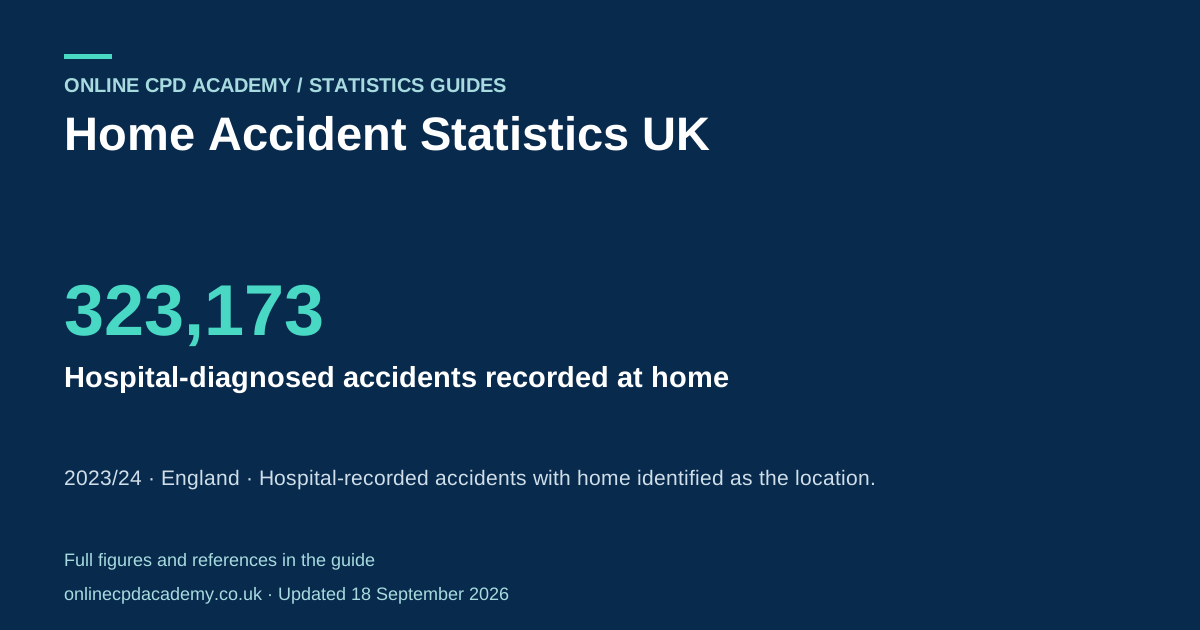
England recorded 323,173 hospital-diagnosed accidents as happening at home in 2023/24, accounting for 40% of diagnosed non-transport accidents. In the same analysis, 51% of diagnosed falls and 65% of injuries involving heat or hot substances occurred at home.
Key statistics at a glance
| Statistic | Figure | Period and coverage |
|---|---|---|
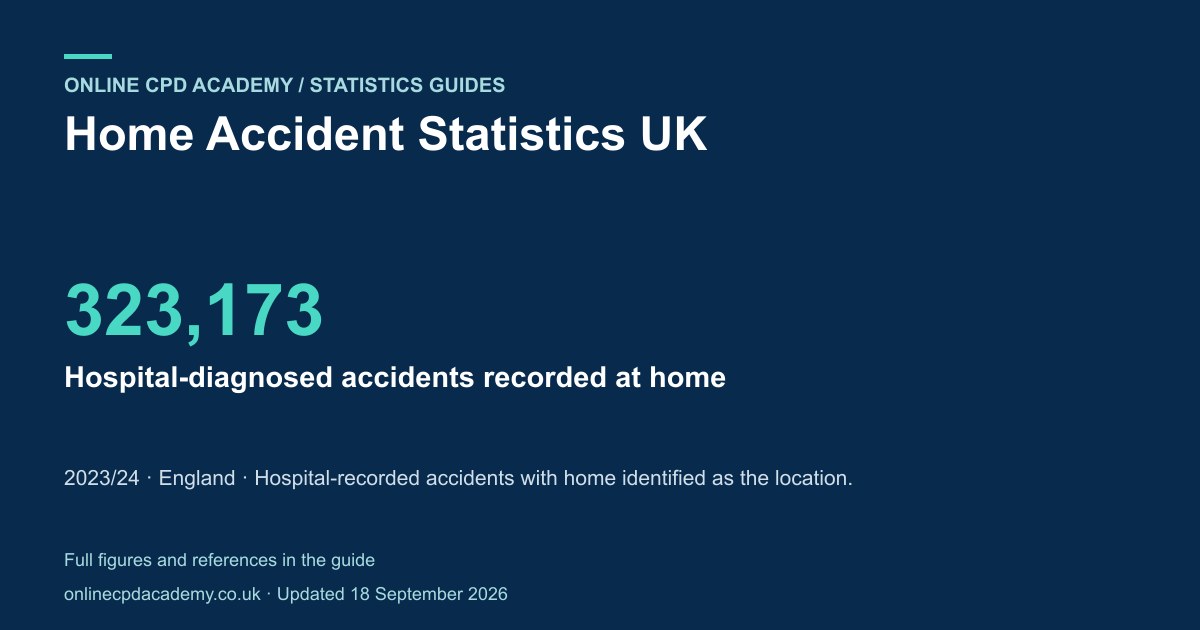
| Hospital-diagnosed accidents recorded at home | 323,173Hospital-recorded accidents with home identified as the location. | 2023/24 England |
| Home share of diagnosed non-transport accidents | 40%Share of diagnosed accidents in the location analysis. | 2023/24 England |
| Diagnosed falls recorded as occurring at home | 51%Share of diagnosed falls with the stated home location. | 2023/24 England |
| Heat or hot-substance injuries recorded at home | 65%Share within this cause-of-injury category. | 2023/24 England |
Home-location figures come from RoSPA’s April 2026 review and cover England in 2023/24. They count recorded hospital diagnoses; broader UK accident totals are presented separately.
How many recorded accidents happen at home?
RoSPA’s 2026 review identifies 323,173 accidents leading to a hospital diagnosis recorded as occurring at home in England in 2023/24. The home accounted for 40% of diagnosed non-transport accidents in that analysis.
Hospital data describe the injuries reaching recorded care. They exclude many minor accidents managed at home, and some hospital records have a missing or unspecified location. The figures count diagnosed accidents rather than unique people.
Falls and heat-related injuries at home
51% of diagnosed falls were recorded as occurring at home. For injuries involving heat or hot substances, the home share was 65%. These percentages identify the home’s contribution within each injury category.
Location and cause provide complementary information: a fall describes how an injury happened, while the home describes where it happened. Keeping both makes the findings useful for identifying household safety priorities.
The wider UK accident picture
Across all settings, RoSPA’s review reports 23,270 accidental deaths in the UK in 2023 and an estimated 896,723 accident-related hospital admissions in 2023/24. Falls accounted for 48% of accidental deaths across all settings.
The UK accidental-death rate per head rose by 8% between 2022 and 2023. These national figures provide the wider context; the home-specific findings above identify the part attributed to a recorded home location.
What accident treatment costs the NHS
RoSPA’s economic appendix estimates £5.4 billion in UK NHS bed-day costs for accidents across all settings. The calculation uses England’s 2022/23 accident admissions, a 2020/21 average cost per day and population scaling to the UK.
This is a modelled treatment-cost measure. A home-only cost estimate would require activity and costing specifically linked to accidents occurring at home.
Practical priorities for home safety
NHS falls guidance highlights reducing trip hazards, improving lighting and seeking help for balance or mobility difficulties. Strength and balance activity and a review of relevant medicines can also form part of prevention.
Carbon monoxide prevention includes suitable alarms, maintained fuel-burning appliances and ventilation. Barbecues and camping stoves should stay outside. If carbon monoxide poisoning is suspected, go outside and seek medical advice promptly. Alarm requirements depend on the nation and housing circumstances.
Frequently asked questions
How many accidents happen at home?
RoSPA reports 323,173 hospital-diagnosed accidents recorded at home in England in 2023/24. This covers hospital-recorded diagnoses, rather than every household accident.
What proportion of recorded falls happen at home?
In the England 2023/24 analysis, 51% of diagnosed falls were recorded as occurring at home.
Does the £5.4 billion figure cover home accidents only?
The £5.4 billion estimate covers UK NHS bed-day costs for accidents across all settings, using 2022/23 activity and earlier unit costs.
Using these statistics?
Please credit Online CPD Academy and link to this guide when using these statistics in an article, report or website.
Suggested citation: Online CPD Academy, Home Accident Statistics UK: Injuries, Falls and Costs (2026), updated 18 September 2026.
Sources
- RoSPA — Annual Review of Accidents 2026: Rising deaths, deepening divides (especially pages 7–8, 12–15 and 20)
- RoSPA — Safer Lives, Stronger Nation, Appendix 3: Economic statistics
- NHS — Falls
- NHS — Carbon monoxide poisoning
- UK Government — Smoke and Carbon Monoxide Alarm (Amendment) Regulations 2022: guidance for landlords and tenants
- Scottish Government — Home fire safety
From food hygiene and fire safety to first aid, mental health and more, we offer a wide range of accredited, online courses you can start today.
Browse all 22 accredited courses →
Mark writes about workplace and home safety, compliance and accredited online training for Online CPD Academy, the UK's leading online training company.