
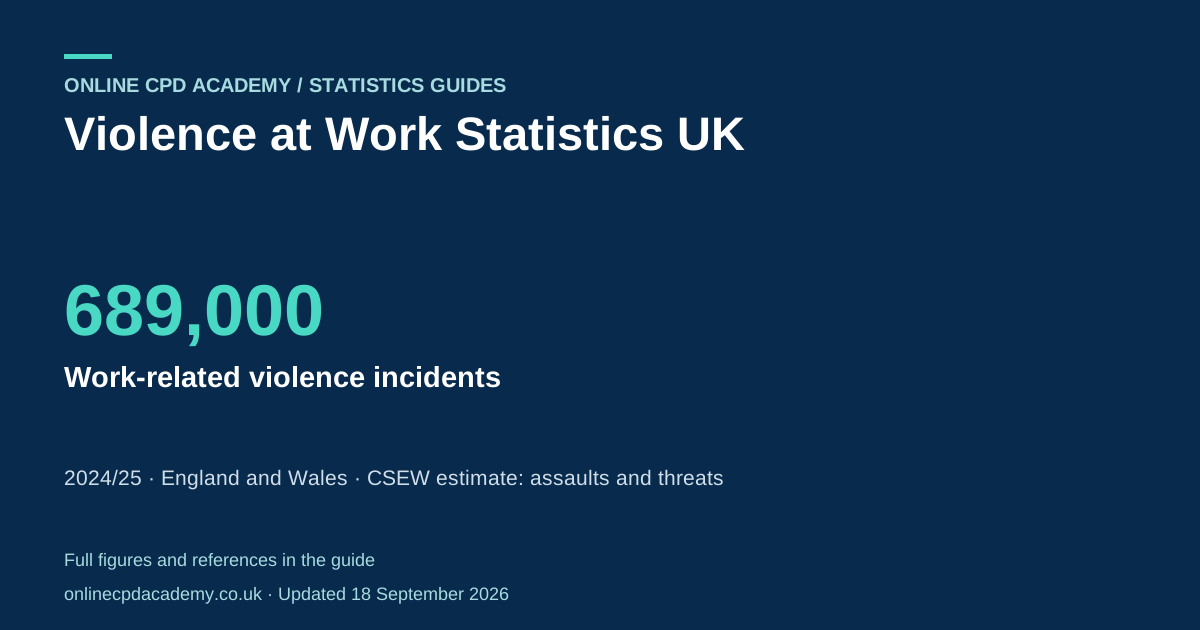
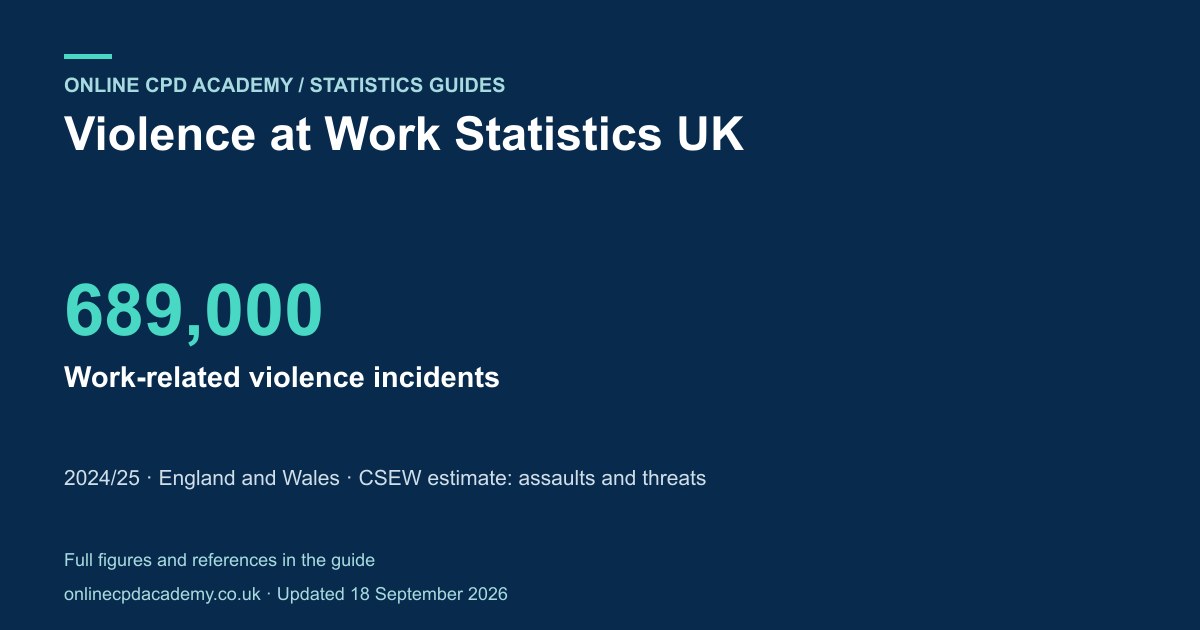
An estimated 689,000 incidents of violence at work occurred in England and Wales in 2024/25: 370,000 assaults and 319,000 threats. Around 329,000 working-age adults experienced at least one incident.
Key statistics at a glance
| Statistic | Figure | Period and coverage |
|---|---|---|
| Work-related violence incidents | 689,000CSEW estimate: assaults and threats | 2024/25 England and Wales |
| Physical assaults | 370,000Includes assaults without physical injury | 2024/25 England and Wales |
| Threats | 319,000CSEW work-related threats | 2024/25 England and Wales |
| Adults experiencing at least one incident | 329,000Working-age adults; people, not incidents | 2024/25 England and Wales |
The headline figures are Crime Survey for England and Wales estimates for 2024/25. Separate sections cover UK retail surveys, the NHS Staff Survey in England and a broader UK workplace-abuse survey. Their populations and definitions differ.
How many workers experience violence?
HSE estimates that 329,000 workers experienced at least one violent incident in 2024/25. The larger total of 689,000 incidents reflects the fact that a person can experience repeated assaults or threats. Physical injury resulted from 38% of assaults.
The analysis covers people aged 16–64 in paid work at interview, including those working from home. Incidents involving a domestic relationship are excluded.
Which occupations face higher risks?
Across the combined 2023/24 and 2024/25 survey years, 6.8% of protective-service workers experienced violence at least once, compared with 1.2% across all occupations. The estimate for health and social care associate professionals was 2.7%.
Transport and mobile-machine operatives, sales occupations, and other managers and proprietors also appeared among the five groups with the highest estimated proportions. The survey estimates have sampling uncertainty.
UK retail violence and abuse
The BRC’s 2026 Crime Report estimates about 1,600 incidents of violence and abuse a day for 1 September 2024 to 31 August 2025. The previous report estimated 2,000 a day; the survey was updated for the 2026 edition.
The ACS 2026 report separately estimates 67,000 violent incidents and 950,000 incidents of verbal abuse in UK convenience stores. Its November 2025–January 2026 survey asked about the preceding 12 months. Responses from 43 retail companies representing around 11,000 stores were weighted to estimate the sector totals.
NHS staff experiences in England
In the 2025 NHS Staff Survey, 14.47% of staff at NHS trusts in England reported physical violence from patients, service users, relatives or the public in the preceding year. The corresponding harassment, bullying or abuse measure was 25.25%.
These weighted percentages describe staff experiences and can overlap. The briefing covers 206 trusts; bank-only and general practice staff are reported separately.
Broader workplace abuse in the UK
The Skills and Employment Survey found that 14.3% of employees had experienced at least one surveyed form of abuse over a year. Physical violence was reported by 6.9%, bullying or harassment by 9.0%, and sexual harassment by 2.4%.
The categories overlap. The analysis uses UK fieldwork from 2023 and 2024 and covers employees aged 20–65 who had also been employed a year earlier.
Injury reports and survey estimates
The Labour Force Survey estimates an annual average of 61,000 workers injured through physical violence in Great Britain during 2022/23–2024/25. RIDDOR recorded 5,900 employee injuries from violence in 2024/25, using a narrower reporting threshold.
These sources answer different questions about incidents, people affected and reportable injuries. Their populations overlap, so they are best read alongside one another rather than added into a single total. HSE has no violence-specific estimate of how complete RIDDOR reporting is.
Reporting and preventing violent incidents
Employers need to assess and manage work-related abuse, threats and assault. Incident records and workers’ experiences can identify the tasks, locations and times associated with aggression.
Physical violence is reportable under RIDDOR when it causes death, a specified injury or an injury preventing normal duties for more than seven consecutive days. Over-three-day incapacity must be recorded. Internal records should also capture threats and abuse that fall outside these injury-reporting thresholds.
Frequently asked questions
How many incidents of violence at work occur each year?
HSE estimates 689,000 assaults and threats at work in England and Wales in 2024/25, affecting around 329,000 workers. Separate UK sector surveys cover broader forms of abuse and different populations.
Is workplace violence increasing?
HSE describes annual CSEW incident estimates as fluctuating without a clear trend. Individual sectors can show different patterns: the BRC's 2026 report gives a lower daily estimate than its previous edition, although its survey was updated.
Is verbal abuse included in the statistics?
It depends on the source. The CSEW work-related violence measure includes assaults and threats. BRC violence-and-abuse figures have a broader scope; ACS reports verbal abuse separately. RIDDOR injury totals do not count verbal abuse alone.
Using these statistics?
Please credit Online CPD Academy and link to this guide when using these statistics in an article, report or website.
Suggested citation: Online CPD Academy, Violence at Work Statistics UK: Latest Data and Sources, updated 18 September 2026.
Sources
- HSE — Violence at work 2024 to 2025: headline and occupational statistics
- HSE — Violence at Work Statistics 2024/25
- British Retail Consortium — BRC Crime Report 2026
- Association of Convenience Stores — Crime Report 2026
- Green and colleagues — How Common Is Workplace Abuse? Skills and Employment Survey 2024
- HSE — How employers can protect workers from violence and aggression at work
- HSE — Reporting and learning from violent incidents
- British Retail Consortium — Crime and Shrink Benchmark 2025
- NHS Staff Survey — 2025 National Results Briefing
- SoloProtect — Customer data on attacks on lone workers
From food hygiene and fire safety to first aid, mental health and more, we offer a wide range of accredited, online courses you can start today.
Browse all 22 accredited courses →
Mark writes about workplace health and safety, compliance and accredited online training for Online CPD Academy. About Online CPD Academy.